advertisement born artist

.png)
I'S AGE
A phase where we take extreme care of ourselves…
and somehow forget the most basic form of mental hygiene: childlike joy.
Kinderfreude is not infantilism.
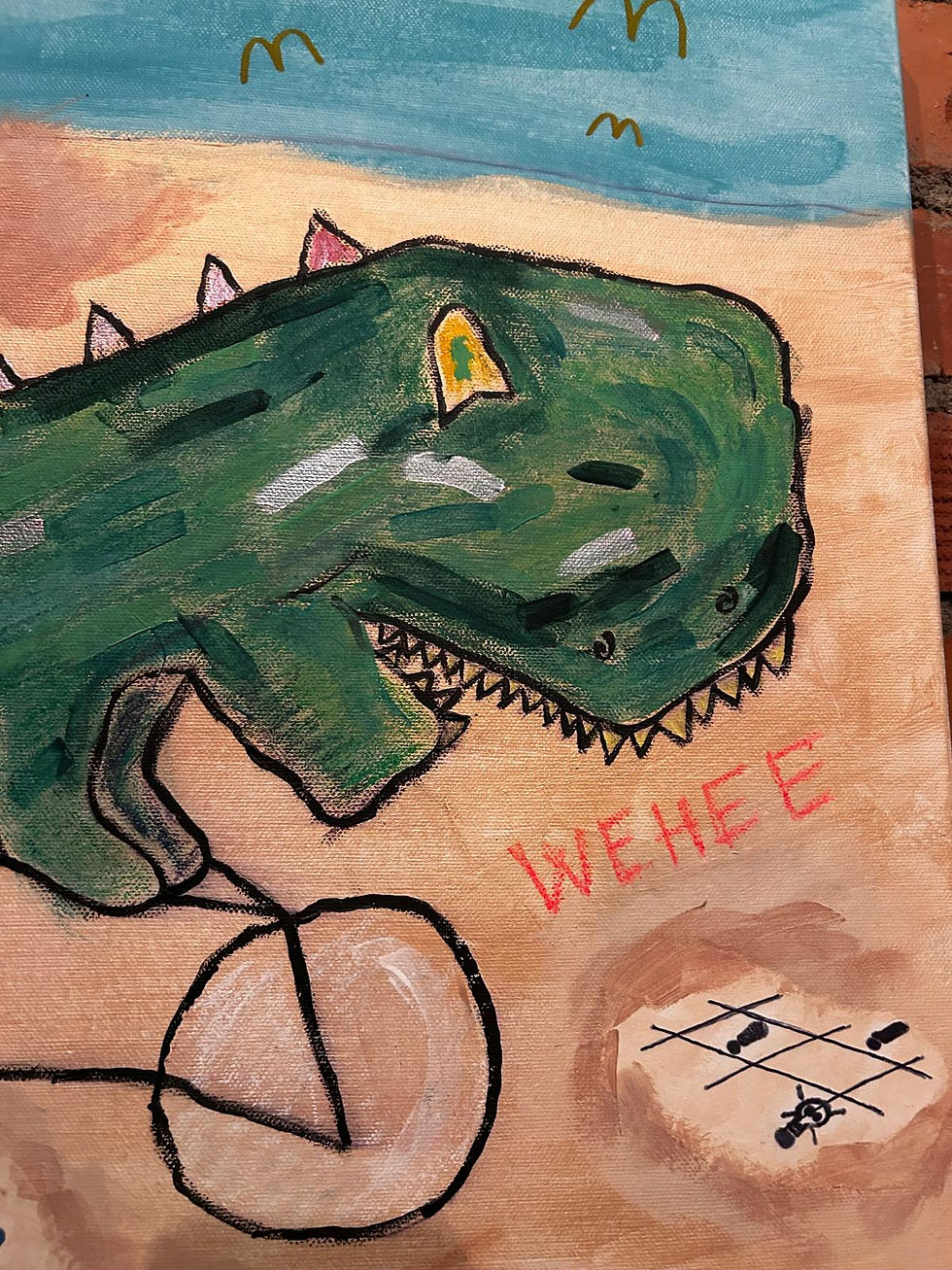
Somewhere between your third emotional breakdown this week and the last unread email, a green dinosaur rides a bicycle.
And enjoys it like an idiot.
This is not a gentle reminder.
We weren’t born cynical.
We learned it.
And we can unlearn it too.
Joy doesn’t go extinct.
So let’s wrestle.
Laugh in the middle of a crisis.
Build a fort.
Kinderfreude is not nostalgia — it’s resistance.
We can pay our bills and still pretend the floor is lava.
Balance, darling.
Stay weird.
Stay curious.
Keep your Kinderfreude.


Diagnosis of a Struggling Adult
Are you a dinosaur without a bike?
Not by age.
By behaviour.
You allow yourself joy only when it makes sense — when it’s justified, productive, or leads somewhere.
If it has no outcome, you don’t even consider it legitimate.
You treat boredom with stimulation, not play.
Instead of space for imagination, experimentation, or silence, you reach for another input, another screen, another distraction.
You play only when it’s “allowed”.
When there’s a scheduled time, a place, a workshop, a course — or at least an audience.
Spontaneous, purposeless play feels suspicious.
Your curiosity exists only when the answer comes fast.
If something can’t be explained quickly, googled instantly, or summarised in three sentences, interest fades.
You divide things into “meaningful” and “pointless”.
And the pointless ones — often the most joyful — get systematically banned.
And somewhere along the way, shame crept in.
Shame around joy, awkwardness, spontaneity — as if they were signs of immaturity, not life.

Then vs.now
When we were bored back then, we invented our own rules.
We counted tiles we weren’t allowed to step on, searched for shapes in clouds, turned sticks into wands, swords, and microphones.
We created private records no one saw and no one judged.
When we’re bored now, we reach for a screen.
We scroll until the will to live quietly disappears, write notes saying “don’t forget to breathe”, and open three apps at the bus stop hoping one of them will solve something for us.
How did we play back then?
We built forts from mattresses and chairs, invented worlds that only made sense to us.
A dinosaur could end up in the kitchen, a unicorn on the sidewalk — reality wasn’t binding.
How do we “play” now?
Only if it’s shareable.
Only if it’s productive.
Only if there’s an output. Preferably measurable.

Deciding for Kinderfreude
Kinderfreude doesn’t happen by accident.
It doesn’t pop up between meetings or after your third meditation.
It starts with a decision:
that you don’t want to live a life where joy is just a side effect of productivity.
It’s a quiet commitment to yourself — to actively look for small joys, playful moments, and beautiful nonsense, even when “nothing comes out of it”.
Not because you should.
But because without them, life hardens quickly.
Kinderfreude in adulthood is not naivety.
It’s a conscious choice.